
Agreed capacity: are you paying for kVA you never use?
How agreed capacity (MIC) is charged on UK half-hourly sites, what happens if you exceed it, and how to decide whether to reduce it using 12 months of kVA data.
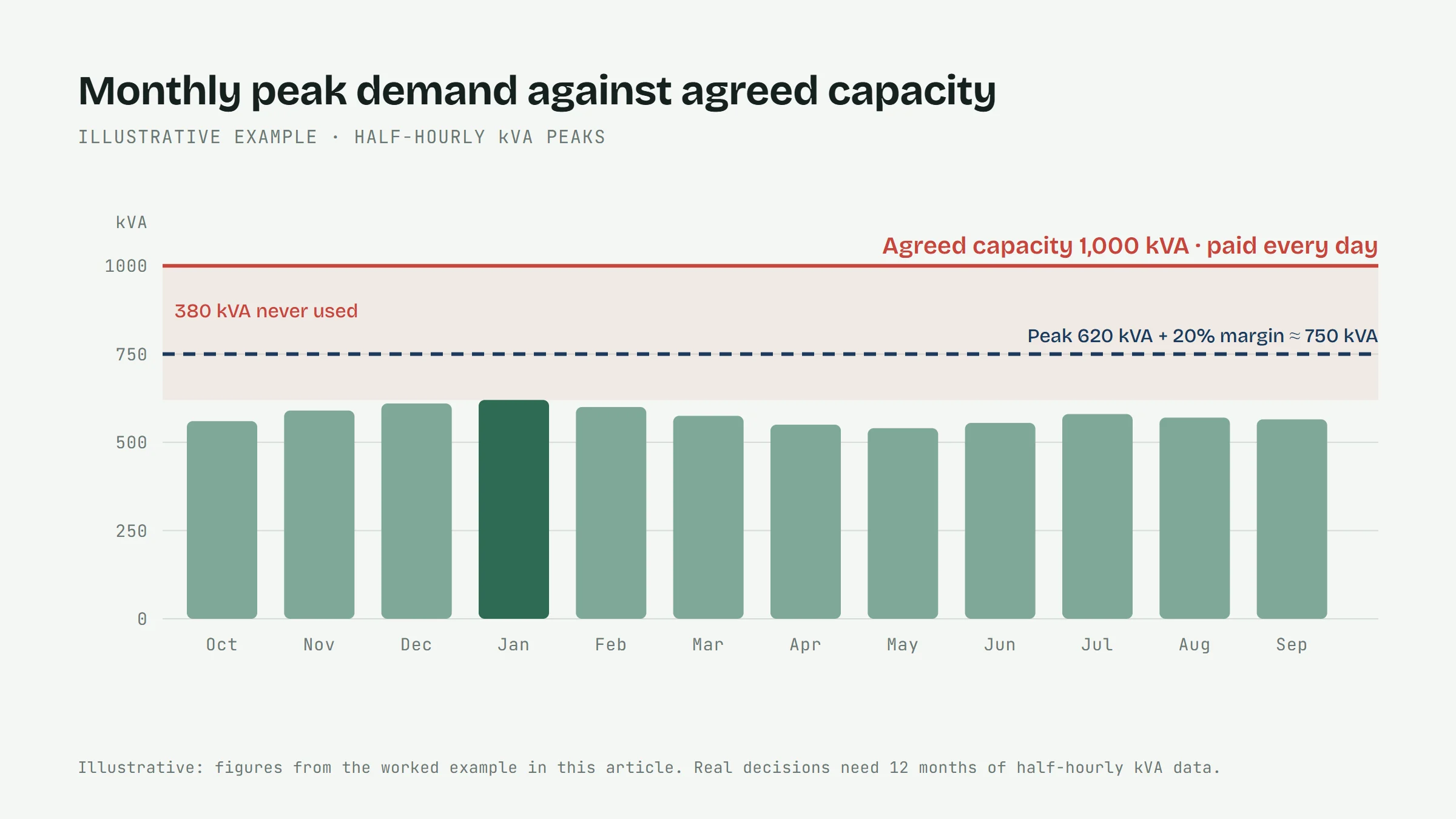
Every half-hourly metered site in Great Britain pays a daily charge for the network capacity it has reserved, whether it uses that capacity or not. This article explains how the charge works, what happens when you exceed your agreed level, and how to decide, with evidence, whether you are paying for capacity you do not need.
What agreed capacity is and where it is set
Agreed capacity is the maximum power, in kVA, that your Distribution Network Operator (DNO) has agreed to make available at your connection point. DNO charging statements call it the Maximum Import Capacity (MIC), for site-specific customers at both low voltage (LV) and high voltage (HV). Suppliers and consultants often call the same figure agreed supply capacity, authorised supply capacity or ASC.
The MIC is agreed with the DNO at connection, or later when requirements change, and recorded in your connection agreement. The charge is part of Distribution Use of System (DUoS) charges, billed by the DNO to your supplier and normally passed through on your invoice.
For LV and HV site-specific tariffs, the 2026/27 charging statements list:
- a fixed charge in pence per MPAN per day
- a capacity charge in pence per kVA per day, applied to your MIC
- an exceeded capacity charge in pence per kVA per day, if you go over your MIC
- unit charges in pence per kWh, and a reactive power charge above a threshold
The chargeable capacity for each billing period is your MIC. A site with 1,000 kVA agreed pays for 1,000 kVA every day, even if it never draws half of it.
Rates vary by region and voltage. As one reference point, London Power Networks’ statement effective from 1 April 2026 lists 7.23 p/kVA/day for LV site-specific tariffs and 9.19 p/kVA/day for HV site-specific tariffs. Your rate is in the statement for your region and tariff.
Why kVA, not kW, is what counts
Capacity is measured in kVA (apparent power), not kW (real power). The link between them is power factor. A site drawing 500 kW at a power factor of 0.95 needs about 526 kVA; the same 500 kW at 0.80 needs 625 kVA.
The charging statements calculate kVA from half-hourly data. For each half hour, demand is twice the square root of active import (kWh) squared plus the larger of reactive import or export (kVArh) squared. Doubling turns half-hourly energy into average demand. The highest half hour in the billing period is compared with the MIC.
Two practical points follow:
- Poor power factor raises your measured kVA and brings you closer to your MIC, even if your kW load is unchanged.
- Better power factor lowers peak kVA for the same kW, which can create room to reduce the MIC. London Power Networks’ statement makes this point directly.
What happens if you exceed your agreed capacity
If the highest half-hourly kVA in a billing period is above your MIC, the difference is exceeded capacity, which the statements describe as unauthorised. It is charged at the exceeded capacity rate on the difference between the MIC and the actual peak, for the full billing period in which the breach occurs. The Southern Electric Power Distribution statement says “for the duration of the full month”.
In the site-specific tariff tables we checked, the exceeded capacity rate equals the ordinary capacity rate, so on DUoS alone a small breach is not a large penalty. The more important consequences are:
- One high half hour sets the excess for the whole month.
- Exceeding the MIC is outside the terms of your connection. The fix is an application to increase it, which is subject to network availability and may require reinforcement at your cost.
- The equipment serving your site was sized around the agreed figure, so persistent overloading is a technical concern, not just a billing one.
Why so many sites are oversized
Agreed capacity is usually set once and then forgotten. Common reasons it no longer matches the load:
- it reflects a historic load, such as a process line or cold store that has since closed
- capacity was requested for an expansion that never happened
- efficiency work, such as LED lighting or variable speed drives, has cut peak demand
- the site changed occupier or use, but the connection agreement stayed the same
- power factor correction was installed after the capacity was agreed
None of this shows on a monthly bill unless someone compares the MIC with the actual peak kVA.
Reducing capacity: the process and the caveats
A reduction is an application to your DNO, not something your supplier can change. The main rules, from the charging statements and DNO guidance:
- Evidence. The new MIC is agreed with reference to the site’s actual maximum demand, so have your own figures first.
- Frequency. Once a MIC is agreed, it cannot be reduced for 12 months, and reductions are allowed only once in a 12-month period.
- Timing. A reduced MIC applies from the start of the next billing period after the request is received. It is not backdated.
- Paperwork. UK Power Networks asks for the MPAN, site address and name, plus a letter of authority if the requester is not the bill payer, then issues a new connection agreement for signature.
- Cost. Electricity North West states there is no charge for reducing the MIC.
- Getting it back. The statements warn that the original capacity “may not be available in the future” without reinforcement and associated charges.
One detail for finance teams: under DCUSA Schedule 32, LV sites with a MIC and HV sites are placed in residual (fixed charge) bands partly by MIC. A reduction does not normally move a site to another band during a price control period; reallocation is limited to exceptional cases, such as a change of use with a MIC change above 50 percent. Count the saving on the capacity charge, not the fixed charge.
How much margin to keep
Cutting the MIC to just above last year’s peak is rarely sensible. Consider:
- Seasonal peaks. Heating, cooling and production cycles vary. Use at least 12 months of half-hourly kVA data.
- Electrification. EV chargers, heat pumps and electric kitchens add large loads quickly, and regaining capacity can be slow and costly.
- Growth. New lines, longer opening hours or a new tenant can raise demand.
- One-off events. Check whether the highest half hour was a fault or test, or a recurring pattern.
A reasonable approach is to set the new MIC at the 12-month peak plus a margin that reflects known plans, and to review it each year.
Illustrative worked example
This example is illustrative. The rate is an assumption; real rates are in your DNO’s charging statement.
A site has 1,000 kVA of agreed capacity. Twelve months of half-hourly data show a highest demand of 620 kVA. Assume a capacity rate of 8 p/kVA/day.
- Current annual charge: 1,000 kVA × £0.08 × 365 = £29,200
- New MIC with a 20 percent margin: 620 × 1.2 = 744, rounded to 750 kVA
- New annual charge: 750 kVA × £0.08 × 365 = £21,900
- Difference: £7,300 a year
If a new load later pushes one half hour to 780 kVA, the excess is 30 kVA. Over a 30-day month: 30 × £0.08 × 30 = £72. Small, but a sign that the margin is being used up.
Measuring before you decide
Enverio measures demand in kW and kVA, and power factor, continuously at the main meter and sub-meters. It tracks peaks against agreed capacity and alerts you as demand approaches the limit, giving you the 12-month evidence base and showing which loads drive the peak. See power quality and energy consumption monitoring.
Our electricity bill validation checks capacity lines on supplier invoices and flags charges billed at the wrong kVA or rate. To look at your own data, contact us.
Frequently asked questions
Is agreed supply capacity the same as Maximum Import Capacity? In practice, yes. DNO charging statements use MIC for LV and HV site-specific customers; agreed or authorised supply capacity (ASC) are common bill names for the same kVA figure.
How often can I reduce my agreed capacity? Once in any 12-month period. Increases within that period may be possible, subject to network availability.
Will a single high half hour cost me for the whole month? Yes. The highest half-hourly kVA in the billing period is compared with your MIC, and any excess is charged for the full period.
Can improving power factor reduce my capacity charge? Not directly, because you pay for the MIC. But lower peak kVA can justify a lower MIC at your next review.
Sources
- London Power Networks, Use of System Charging Statement, effective 1 April 2026 (v1.3)
- Southern Electric Power Distribution (SSEN), Use of System Charging Statement, effective 1 April 2026 (v1.1)
- UK Power Networks, Reduce your electricity supply
- National Grid Electricity Distribution, How to apply for a reduction in capacity
- Electricity North West, Upgrade or reduce your supply
- DCUSA, Schedule 32: Residual Charging Bands (v16.6)
Let us measure what is happening on your site.
In a one-hour call we look at your existing setup and set out exactly which measurement points are needed and what you would be able to see.