
How to check a half-hourly electricity bill, line by line
What each line on a UK half-hourly business electricity bill means, the errors worth checking for, and the evidence you need to dispute a charge.
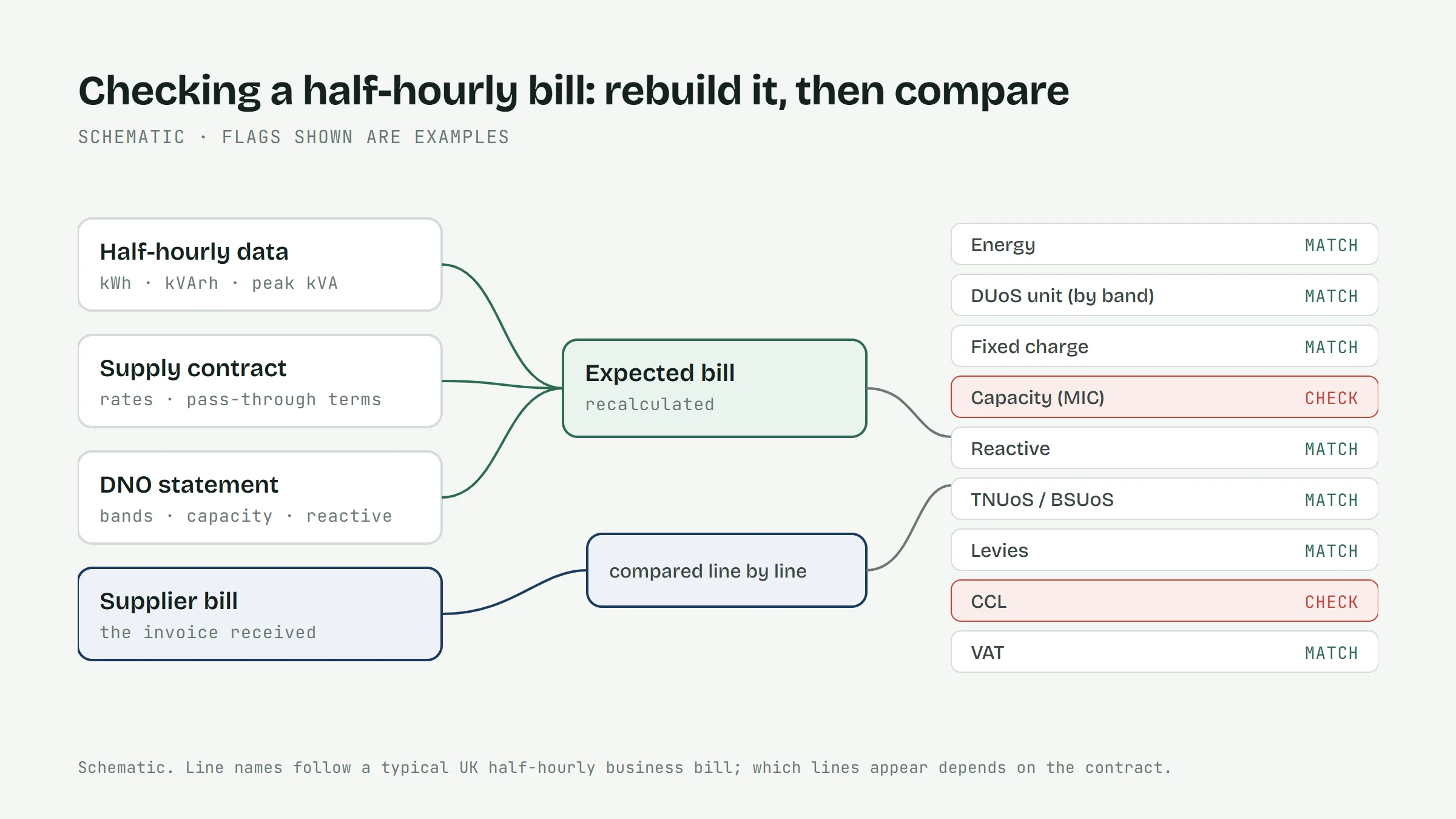
A half-hourly (HH) electricity bill can run to a dozen or more lines, and most of them are not the energy you bought. Network charges, levies, agent fees and taxes are each calculated on a different basis: per kWh, per kVA or per day. That makes the bill hard to check by eye, but it also means each line can be rebuilt independently.
What to gather first
- The bill and its itemised back-up, including the rates applied to pass-through lines.
- Your contract: unit rates, standing charges, which costs are fixed and which are passed through.
- HH data for the billing period, with kWh and kVArh for each half hour, from the supplier, your data collector or your own meter.
- The MPAN. Its top line includes the Line Loss Factor Class (LLFC), which sets your distribution tariff.
- Your distribution network operator’s (DNO) charging statement for the year covering the bill. Its annex lists rates and time bands by LLFC.
- Certificates: Climate Change Levy or Climate Change Agreement, VAT qualifying use, and any energy intensive industries exemption.
Fixed, pass-through, or in between
On a fixed contract, the supplier builds most non-energy costs into the unit rates and standing charges for the term. On a pass-through contract, the energy price is agreed but network charges and levies are billed at cost, so they move when published rates change. Many contracts fix some lines and pass through others. Establish which applies before checking anything: a pass-through line should match the published rate for the period, and a fixed line should match the contract.
The lines on a typical HH bill
| Line | What it is | What to check |
|---|---|---|
| Energy | The commodity, sometimes split by time band | Contract rates; kWh equals the sum of your HH data |
| DUoS unit charges | Distribution charges per kWh in red, amber and green bands | kWh per band matches the DNO’s windows for your LLFC |
| DUoS fixed charge | Daily charge per MPAN, including the distribution residual | Number of days; correct residual band |
| DUoS capacity charge | p/kVA/day on your Maximum Import Capacity (MIC) | kVA matches your agreed MIC |
| Excess capacity | p/kVA/day on demand above MIC | Your actual peak kVA |
| Excess reactive power | p/kVArh above the power factor threshold | Recalculate from HH kWh and kVArh |
| TNUoS | Transmission charges: banded fixed residual plus a locational element | Correct band; Triad demand if applicable |
| BSUoS | Balancing costs per MWh | Published tariff for the period |
| RO, FiT, CfD | Renewable scheme costs passed on by suppliers | Basis per contract; exemption if certified |
| Capacity Market | Levy based on winter weekday peak demand | Basis and period per contract |
| AAHEDC | Levy supporting high-cost distribution areas | Published annual tariff |
| MOP, DC, DA | Meter operator, data collection and aggregation | Contracted fee; not billed twice |
| Climate Change Levy | Tax per kWh | Main rate, CCA reduction or exclusion |
| VAT | Tax on the total | 20% unless qualifying use or de minimis applies |
Network charges: where most of the checking effort goes
Distribution use of system (DUoS) charges for HH sites typically have five parts: a fixed daily charge, a capacity charge on your MIC, an excess capacity charge, three time-banded unit charges and a reactive power charge. Time windows differ by DNO area. In London Power Networks’ 2026/27 statement, for example, red runs 11:00 to 14:00 and 16:00 to 19:00 on weekdays including bank holidays, weekends are all green, and times are UK clock time.
The same statement explains the capacity lines. Each half hour, demand in kVA is taken as twice the square root of (kWh² + kVArh²) and compared with the MIC; the highest excess is charged for the whole billing period. Excess reactive power applies when kVArh exceeds 33% of kWh in a half hour, equivalent to a power factor of 0.95, and the excess units are summed. Our guide to reactive power charges covers that line in detail. Under the same statement, a MIC cannot be reduced for 12 months after it is agreed.
Following Ofgem’s Targeted Charging Review, network residual costs are recovered through fixed charges instead of per kWh: distribution from April 2022, transmission from April 2023. Non-domestic sites fall into one of four residual bands, so a wrong band means a wrong daily charge for as long as it persists. For HH sites, the locational part of transmission charges is still based on demand during the Triads, the three peak half hours of each winter. Since April 2023, BSUoS has been charged to final demand only, as a tariff fixed in advance for six-month periods.
Levies and taxes
The Renewables Obligation, Feed-in Tariffs, Contracts for Difference, the Capacity Market and AAHEDC are charged to suppliers, who pass them on, each on its own basis. The Capacity Market levy, for instance, is shared out by demand between 4pm and 7pm on working days from November to February. Rates are reset annually or quarterly, so use the figure published for the billing period. Certified energy intensive industries can be exempted from renewable scheme costs; if you hold a certificate, check the exemption appears.
HMRC’s Climate Change Levy main rate for electricity is £0.00801 per kWh from 1 April 2026 to 31 March 2027. Climate Change Agreement holders receive a 92% discount on electricity, applied once the supplier has their certificate. Domestic use, charity non-business use and electricity under 1,000 kWh a month are excluded.
VAT is 20% on most business electricity. The 5% rate applies to domestic or charity non-business use, or to supplies of no more than 33 kWh a day or 1,000 kWh a month. On mixed premises, if at least 60% is qualifying use, the whole supply can be treated as qualifying.
Common errors and how to spot them
- Estimated data when the meter failed to communicate. Check that any re-bill replaces the original rather than adding to it.
- Wrong MPAN or meter, especially after a site change or new connection.
- Totals that differ from your HH data for the same period.
- Wrong time-band allocation: check bank holidays, weekends and the clock-time rule.
- Clock-change days. Settlement periods follow local time, so the day clocks go forward has 46 half hours and the day they go back has 50. The next long day is 25 October 2026.
- Capacity, excess capacity or reactive charges that your own HH data does not support.
- CCL or VAT at the wrong rate, for example the CCL main rate despite a valid certificate.
- Duplicates: overlapping periods, two fixed charges where one applies, agent fees billed twice.
- Contract mismatch: a fixed line billed at a pass-through rate, or old rates after renewal.
Disputing a charge
Put the dispute in writing with the MPAN, bill number, each line in question, your recalculation, the source of every rate used and the HH data behind it.
Some late adjustments are legitimate. Settlement is currently reconciled over about 14 months, which the London Power Networks statement says will fall to four months under market-wide half-hourly settlement. The DNO assigns the LLFC, and its statement explains how to challenge an allocation; in practice you raise it through your supplier.
Protection against old bills depends on business size. Ofgem’s ban on back-billing for energy used more than 12 months ago covers domestic customers and microbusinesses: broadly, fewer than 10 employees and a small turnover or balance sheet, or no more than 100,000 kWh of electricity a year. Since 19 December 2024, small businesses (fewer than 50 employees and turnover up to £6.5 million or balance sheet up to £5 million, or up to 200,000 kWh of electricity a year) can take unresolved complaints to the Energy Ombudsman, but the back-billing ban was not extended to them. Larger businesses rely on contract terms, the supplier’s complaints process and general law; in England and Wales, a claim on a simple contract must be brought within six years.
How Enverio helps
Enverio’s electricity bill validation rebuilds the expected bill from metered data and contract terms, compares it line by line with the bill received, flags deviations and produces a one-page dispute record. For UK sites, the tariff structure, DNO charges and contract terms are configured per site and per contract.
The recalculation depends on the consumption data. Enverio’s energy consumption monitoring holds HH and sub-metered data, so the kWh, kVArh and peak kVA behind each line can be checked independently of the supplier’s file. To discuss a site, contact us.
Frequently asked questions
How often should I check a half-hourly bill? Ideally every bill. At minimum, check the lines driven by your own data (consumption, capacity and reactive power) and recheck pass-through rates when published rates change.
Where do I find the DUoS rates for my site? In your DNO’s charging statement for the relevant year. Use the LLFC from the top line of your MPAN to find the tariff and time bands.
Does the 12-month back-billing limit protect my business? Only if you are a microbusiness. Small businesses can use the Energy Ombudsman; larger businesses depend on contract terms and general law.
Why did my standing charge rise so much? Since 2022 for distribution and 2023 for transmission, network residual costs have been recovered through banded fixed charges rather than per kWh. Check that your site is in the correct band.
Sources
- London Power Networks: Use of System Charging Statement, effective 1 April 2026
- Ofgem: Targeted Charging Review decision and impact assessment
- Ofgem: Decision on CMP343
- NESO: Transmission Network Use of System charges
- NESO: Balancing Services Use of System charges
- NESO: AAHEDC
- EMR Settlement: G15 Capacity Market supplier payments
- Ofgem: Renewables Obligation
- Ofgem: Feed-in Tariffs levelisation
- Low Carbon Contracts Company: Supplier CfD FAQs
- GOV.UK: Energy intensive industries exemption from CfD, RO and FiT costs
- GOV.UK: Climate Change Levy rates
- GOV.UK: Excise Notice CCL1/3, reliefs and special treatments
- GOV.UK: VAT on fuel and power (Notice 701/19)
- Elexon: Settlement and invoicing
- GOV.UK: When do the clocks change
- Ofgem: Suppliers banned from back-billing beyond 12 months (March 2018)
- Ofgem: Micro business consumer definition
- GOV.UK: Expanding Energy Ombudsman access to small business consumers
- Ofgem: Non-domestic market review decision (2024)
- Limitation Act 1980, section 5
Let us measure what is happening on your site.
In a one-hour call we look at your existing setup and set out exactly which measurement points are needed and what you would be able to see.