
Reactive power charges on UK electricity bills: a practical guide
How the DUoS excess reactive power charge works for half-hourly metered sites, what it realistically costs, and when power factor correction pays back.
If your site is half-hourly metered, your bill may carry a line for excess reactive power, priced in pence per kVArh. It is one of the smaller distribution charges, and for many sites it is modest. The power factor behind it matters more: it also drives your capacity charge and your cable and transformer loading.
Reactive power and power factor in plain terms
- Active energy (kWh) does the useful work: heat, motion, light.
- Reactive energy (kVArh) is the energy that motors, transformers and some lighting draw to build magnetic fields. It flows back and forth without doing work, but the network still has to carry it.
- Apparent power (kVA) is the total the cables and transformers see.
- Power factor is kW divided by kVA. At 0.95, 100 kW needs about 105 kVA. At 0.85, it needs about 118 kVA.
Inductive loads give a lagging power factor. Capacitors, long cables and some electronic equipment push it the other way, towards leading.
Who pays the charge
The excess reactive power charge is a Distribution Use of System (DUoS) charge. Each distribution network operator (DNO) publishes it in its annual charging statement under the Common Distribution Charging Methodology (CDCM).
- It applies to individual half-hourly metered MPANs on LV and HV site-specific tariffs. The aggregated tariffs used for smaller supplies have no reactive rate.
- Sites on EHV (EDCM) tariffs have no separate reactive charge. UK Power Networks notes that poor power factor can still raise their unit charges.
- DNOs expect reactive data for these meters. If it is missing, they estimate it: London Power Networks applies a power factor of 0.9, SSEN’s southern network 0.95 lagging.
How the charge reaches you depends on your supply contract. Pass-through contracts usually show it as a separate line; fixed contracts may bundle it.
How the charge is calculated
The charging statements set the threshold at 33% of active energy in each half-hour, which they describe as equivalent to a power factor of 0.95. For every half-hour:
Chargeable kVArh = max( max(reactive import, reactive export) − 0.33 × active import, 0 )
The 0.33 comes from √(1/0.95² − 1) = 0.3287, which the statements say is calculated to two decimal places. The half-hourly results are added up over the billing period and multiplied by the rate.
Two details matter in practice:
- No averaging across the month. A good daytime power factor does not cancel a poor night-time one. At night, when active load is low, the magnetising demand of transformers and motors left running can push the ratio over the limit.
- Leading counts too. The formula takes the larger of reactive import and reactive export. A bank that overcorrects at low load can be charged just as a missing bank would. Rates vary by DNO and voltage. Two examples from statements effective 1 April 2026, in pence per kVArh, excluding VAT:
| Network area | LV Site Specific | LV Sub Site Specific | HV Site Specific |
|---|---|---|---|
| London Power Networks (UKPN) | 0.522 | 0.323 | 0.244 |
| Southern Electric Power Distribution (SSEN) | 0.251 | 0.138 | 0.098 |
A worked example
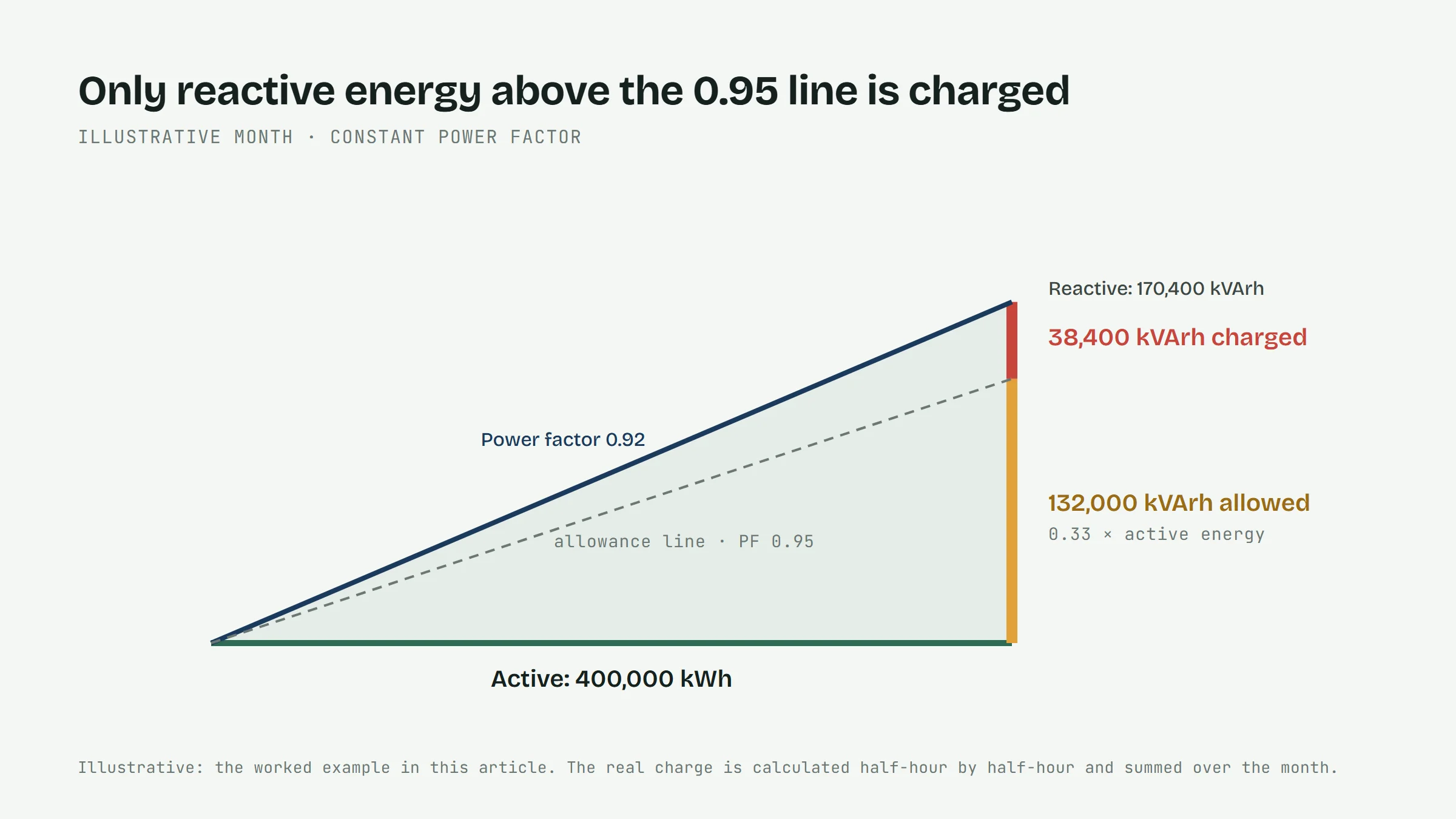
This example is illustrative. It assumes an LV site-specific supply using 400,000 kWh a month at a constant lagging power factor of 0.92 in every half-hour.
- Reactive-to-active ratio: tan(acos 0.92) = 0.426
- Reactive energy: 400,000 × 0.426 = 170,400 kVArh
- Allowance: 0.33 × 400,000 = 132,000 kVArh
- Excess: 170,400 − 132,000 = 38,400 kVArh
- Cost at the SSEN southern LV rate (0.251 p): 38,400 × 0.251 p = £96.38 a month, about £1,157 a year
- Cost at the London LV rate (0.522 p): 38,400 × 0.522 p = £200.45 a month, about £2,405 a year
For a site using 4.8 GWh a year, that is a small line. Real bills are worked out half-hour by half-hour, so a site with an average of 0.92 can pay more or less than this. A site that stays at 0.95 or better in every half-hour pays nothing.
Why power factor matters beyond the reactive line
The stronger reasons to care are usually these:
- Capacity. The capacity charge is billed in p/kVA/day on your agreed Maximum Import Capacity (MIC). If your actual kVA goes over the MIC, the excess is charged for the whole billing period. Reactive energy counts in that kVA figure. Illustration: an 800 kW peak at 0.92 is about 870 kVA. At 0.98 it is about 816 kVA. If that lets you lower your MIC by 53 kVA, the saving at SSEN’s southern LV rate of 10.63 p/kVA/day would be about £2,060 a year. Check the rules first: an MIC can normally be reduced only once in 12 months, and getting capacity back later may need paid reinforcement.
- Current and losses. For the same kW, current rises as power factor falls. Going from 0.98 to 0.92 raises current by about 6.5% and resistive losses in the same cable by about 13%.
- Headroom. Transformers and cables are rated in kVA and amps. Poor power factor uses up capacity you might need for new load, such as heat pumps or EV charging.
- Diagnosis. A sudden fall in power factor on a site with correction installed often points to a failed capacitor stage or a stuck contactor.
Power factor correction: options and risks
- Fixed capacitors at large motors or across a transformer. Simple, but only suited to steady loads.
- Automatic stepped banks at the main switchboard, switched in and out by a controller as load changes. This is the usual choice.
- Detuned banks, with reactors in series with the capacitors. They are advisable where drives, UPS systems, LED drivers or chargers produce harmonics, because they stop the bank resonating with the network.
- Active filters or static var generators for fast-changing loads or high harmonic levels. They cost more but respond much faster than switched capacitor steps.
The main risks:
- Overcompensation at low load, giving a leading power factor that is still chargeable and can raise voltage.
- Resonance between capacitors and transformer inductance, which amplifies harmonics and overheats capacitors.
- Ageing. Capacitors lose capacitance and fuses blow, so a bank that worked when fitted can drift out of range without anyone noticing.
When correction is worth it
- Pull 12 months of bills and check the reactive line. Then get half-hourly data with reactive columns from your supplier or data collector, so you can see which hours cause the charge.
- If the charge is small and capacity is comfortable, servicing an existing bank is usually better value than buying a new one.
- The case is stronger when you are close to your MIC, have paid exceeded capacity, are near transformer limits or are adding load.
- Measure harmonics before you specify a bank. That decides between a standard and a detuned design.
- Judge payback on the combined saving across reactive charges, capacity and losses, not on the reactive line alone.
Seeing it before it reaches the bill
Enverio monitors power factor, reactive power, harmonics and phase imbalance at the main meter and on individual feeders. It shows the hours spent outside the 0.95 limit and projects during the month whether a reactive charge is likely.
Where correction is installed, it can suggest which correction steps to check or adjust. It does not install capacitor banks. The approach is described on the power quality page, and you can contact us to discuss a site.
Frequently asked questions
Is the reactive charge calculated on my monthly average power factor? No. It is calculated for every half-hour and the chargeable units are added up. A good monthly average can still hide half-hours that are charged.
Can I be charged for a leading power factor? Yes, under the published CDCM formula. It uses the larger of reactive import and reactive export in each half-hour, so overcorrection at low load can be charged.
Does improving power factor reduce my capacity charge automatically? No. The capacity charge is based on your agreed MIC. Better power factor lowers your actual kVA and can help you avoid exceeded capacity charges. It only reduces the standing capacity charge if you agree a lower MIC with your DNO.
Sources
- London Power Networks plc, Use of System Charging Statement, effective 1 April 2026 (v1.3)
- Southern Electric Power Distribution plc, Use of System Charging Statement, effective 1 April 2026 (v1.1)
- Ofgem, decision on DCUSA DCP222: non-billing of excess reactive power charges (generators)
- Electrical Installation Guide, Power factor correction
- Electrical Installation Guide, Risk of resonance due to power-system harmonics
Let us measure what is happening on your site.
In a one-hour call we look at your existing setup and set out exactly which measurement points are needed and what you would be able to see.