
DUoS red, amber and green bands: why timing affects your bill
How DUoS red, amber and green time bands work on UK half-hourly bills, why they differ by DNO, and how to find load you could move out of the red band.
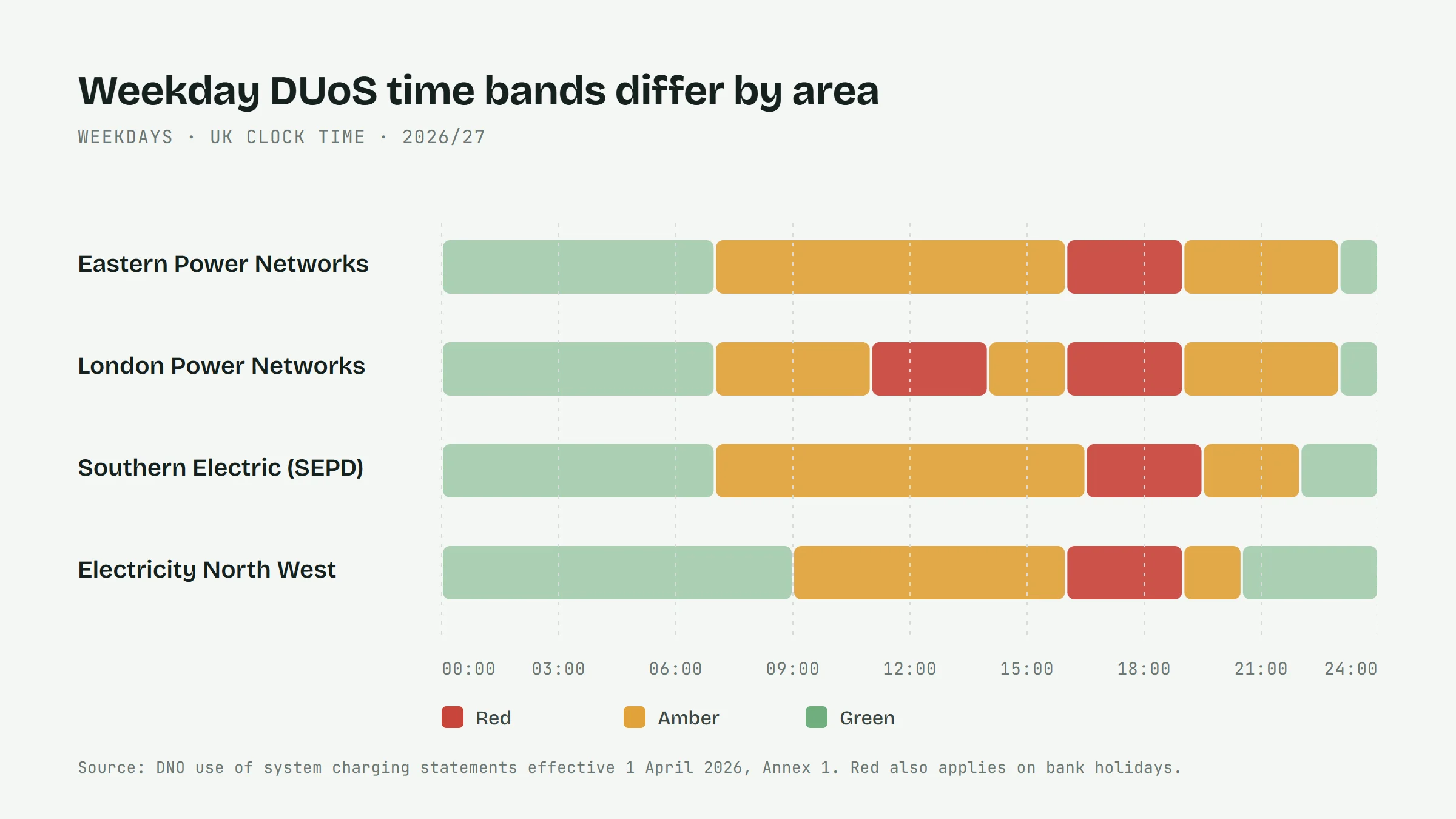
On a half-hourly metered supply, the network charge for a kilowatt-hour depends on when you use it. A unit taken at 17:30 on a weekday can carry a distribution charge many times higher than the same unit at 02:00. For some sites that difference is worth managing; for others it is small, or never reaches the bill.
What DUoS charges are
Distribution Use of System (DUoS) charges pay for the local electricity network. They are set each year by the distribution network operator (DNO) for your licence area and published in its Use of System Charging Statement, prepared under Standard Licence Condition 14. Your supplier pays them and passes them on.
For a half-hourly site connected at low or high voltage, the statements list up to five parts:
- a fixed charge, in pence per MPAN per day
- a capacity charge, in pence per kVA per day, on your agreed Maximum Import Capacity (MIC)
- an excess capacity charge if the site goes above its MIC
- three unit charges, in pence per kWh, for the red, amber and green time bands
- a reactive power charge for kVArh above the allowed threshold
Only the unit charges depend on time of day. Our guide to checking a half-hourly bill covers the other lines.
Band times differ by area
Every DNO uses red, amber and green bands, but the hours differ across the country. The table below is taken from four 2026/27 charging statements, with rates for two common half-hourly demand tariffs, LV Site Specific Band 1 and HV Site Specific Band 1.
| Licence area (2026/27) | Weekday red | Weekends | LV Band 1 red / green (p/kWh) | HV Band 1 red (p/kWh) |
|---|---|---|---|---|
| Eastern Power Networks | 16:00–19:00 | All green | 8.149 / 0.108 | 4.837 |
| London Power Networks | 11:00–14:00 and 16:00–19:00 | All green | 4.444 / 0.024 | 0.230 |
| Southern Electric Power Distribution | 16:30–19:30 | Amber 09:30–21:30 | 6.589 / 0.028 | 1.266 |
| Electricity North West | 16:00–19:00 | Amber 16:00–19:00 | 7.832 / 0.024 | 1.998 |
All the statements apply red on weekdays including bank holidays, all year, and all times are UK clock time. Amber hours differ too: in the North West, amber runs from 09:00, while the Eastern area uses 07:00.
Two conclusions follow. First, you need your own DNO’s statement: a load moved to 16:00 is out of red in Southern’s area but not in the Eastern area. Second, the red premium varies widely. The LV Band 1 red rates above run from about 4.4p to 8.1p per kWh, and some HV rates are well under 1p. Find your tariff from the line loss factor class (LLFC) in your MPAN details, then look up the matching row.
What the Targeted Charging Review changed
Network charges have two parts. Forward-looking charges signal the cost of using the network at busy times and places; residual charges recover the rest of the allowed revenue. Under its Targeted Charging Review (TCR) decision of November 2019, Ofgem moved residual charges onto fixed charges for final demand. For distribution this took effect on 1 April 2022, and for transmission on 1 April 2023. Non-domestic sites pay a fixed daily charge set by which of four residual bands they fall into.
This matters for load shifting in three ways:
- The residual is fixed per site. Ofgem has said that consumers should not change their behaviour to avoid residual charges, and moving load does not change it.
- Time-banded DUoS unit rates still exist, but as the table shows, their size varies a great deal by area, voltage and band.
- Triads have changed. Before April 2023, the transmission (TNUoS) residual was part of the charge on half-hourly demand during the three winter peak half hours, known as Triads. That residual is now a fixed charge. The Triad charge keeps only the locational element, floored at zero where it would be negative, so Triad avoidance is worth much less than it was, and in some zones nothing. Check your zone’s current tariff with the National Energy System Operator (NESO).
Does moving load save you money?
That depends on your supply contract. UK Power Networks’ charging statement says that shifting demand to a cheaper period may help, “although the ability to directly benefit will be linked to the structure of your supply charges”.
- Pass-through contracts. Where DUoS is passed through at cost, your bill shows kWh in each band multiplied by the DNO rates. Moving load out of red reduces the bill directly.
- Fixed or bundled contracts. Where network costs are built into a flat or day/night unit rate for the contract term, moving load within the term does not change what you pay per kWh. It may matter at renewal if the supplier prices your consumption profile. Ask how DUoS is treated before rescheduling anything.
An illustrative calculation
These figures are illustrative round numbers, not a quote. Suppose a site on a pass-through contract moves 200 kWh a day of weekday load from red into green. Take a red rate of 8.0p/kWh and a green rate of 0.1p/kWh:
- Saving per weekday: 200 kWh × (8.0p − 0.1p) = 1,580p = £15.80
- Over about 260 weekdays: £15.80 × 260 = £4,108 a year
At an HV site where the red rate is 0.23p/kWh, the same shift would save 200 × 0.23p = 46p a day, or about £120 a year. The actual figures come from your DNO charging statement and your supply contract.
Finding load you could move
Start with at least a few months of half-hourly data, and sub-metered data if you have it.
- Map the bands onto your data. Mark the red, amber and green half hours for your area. Check whether your export uses UTC or UK clock time; the bands follow clock time.
- Build an average weekday profile. If the red half hours look like a continuation of the afternoon rather than a dip, nobody has scheduled around them.
- Look at a heatmap by hour and weekday. Loads that repeat at the same time each day, such as a timer, a batch or a charging session, show up as stripes.
- Break it down by system. Sub-meters show which plant runs in red: HVAC, refrigeration, compressors, pumps, kitchens or chargers.
Loads that can often move include:
- Heating and cooling. Pre-heat or pre-cool buildings before red starts, and let temperature drift within agreed limits during it.
- Pumps. Fill tanks and reservoirs earlier, then stop filling during red, where storage allows.
- Compressed air. Stagger non-essential compressors and air-hungry cleaning tasks.
- Batch processes. Move washing, mixing or forklift charging that is not tied to a shift pattern.
- EV charging. Delay fleet charging until after red where vehicles stay parked overnight.
Some loads should not move: safety-critical systems, medical equipment, fire and life-safety plant, refrigeration that protects food or medicines, and production that customers and shift patterns depend on. Watch capacity too. Stacking several loads into the same green half hour can create a new peak and trigger excess capacity charges if the site exceeds its MIC. Agree any timing change with the people who run the plant.
How Enverio helps
Enverio’s energy consumption monitoring shows sub-metered consumption by hour, area and system, with heatmaps and day profiles, so you can see what runs in the red band and whether a change has stuck. It does not calculate DUoS for you; band times and rates come from your DNO’s statement and your contract.
Where a load can be moved, remote control and scheduling can switch or time it to a set programme. Bill validation compares the charges billed with metered data, so you can check whether the savings reach the invoice. To discuss a specific site, contact us.
Frequently asked questions
Are the red band times the same everywhere in Great Britain? No. Each DNO sets its own. In 2026/27, London has two weekday red periods (11:00–14:00 and 16:00–19:00), Southern Electric uses 16:30–19:30, and some areas have amber periods at weekends.
Did the Targeted Charging Review remove time-of-use charges? No. It moved residual costs to fixed daily charges from 2022 (distribution) and 2023 (transmission). DUoS unit rates by red, amber and green band remain, though the size of the red premium varies by area, voltage and band.
Will moving load out of the red band reduce my bill? Only if your contract passes DUoS through, or reflects it in a time-banded way. On a fully fixed contract, the saving may not appear until renewal, if at all.
Where do I find the rates for my site? In your DNO’s current Use of System Charging Statement. Match the LLFC from your MPAN details to the tariff table, and ask your supplier how those rates apply under your contract.
Sources
- Eastern Power Networks plc, Use of System Charging Statement, effective 1 April 2026 (v1.3)
- London Power Networks plc, Use of System Charging Statement, effective 1 April 2026 (v1.3)
- Southern Electric Power Distribution plc, Use of System Charging Statement, effective 1 April 2026 (v1.1)
- Electricity North West, Schedule of charges and other tables 2026/27 (v1.1)
- UK Power Networks, Distribution Use of System charges (Annex 1 open data)
- Ofgem, Targeted Charging Review: decision and impact assessment
- Ofgem, decision on DCUSA DCP361: TCR implementation, calculation of charges (implementation 1 April 2022)
- Ofgem, decision on CUSC CMP336: Transmission Demand Residual billing (implementation 1 April 2023)
- Ofgem, CMP343 minded-to decision and draft impact assessment (flooring of demand locational charges)
- NESO, Transmission Network Use of System (TNUoS) charges
Let us measure what is happening on your site.
In a one-hour call we look at your existing setup and set out exactly which measurement points are needed and what you would be able to see.