
ESOS Phase 4: what the timeline means for your energy data
ESOS Phase 4 qualification is 31 December 2026 and notifications are due 5 December 2027. What the rules ask of your energy data, and why metering comes first.
The Energy Savings Opportunity Scheme (ESOS) runs in four-year phases. The Phase 4 deadline most people remember is December 2027, but the dates that matter for your data are earlier, and some of the evidence you will need can only be collected before an energy saving measure goes in.
The Phase 4 timeline at a glance
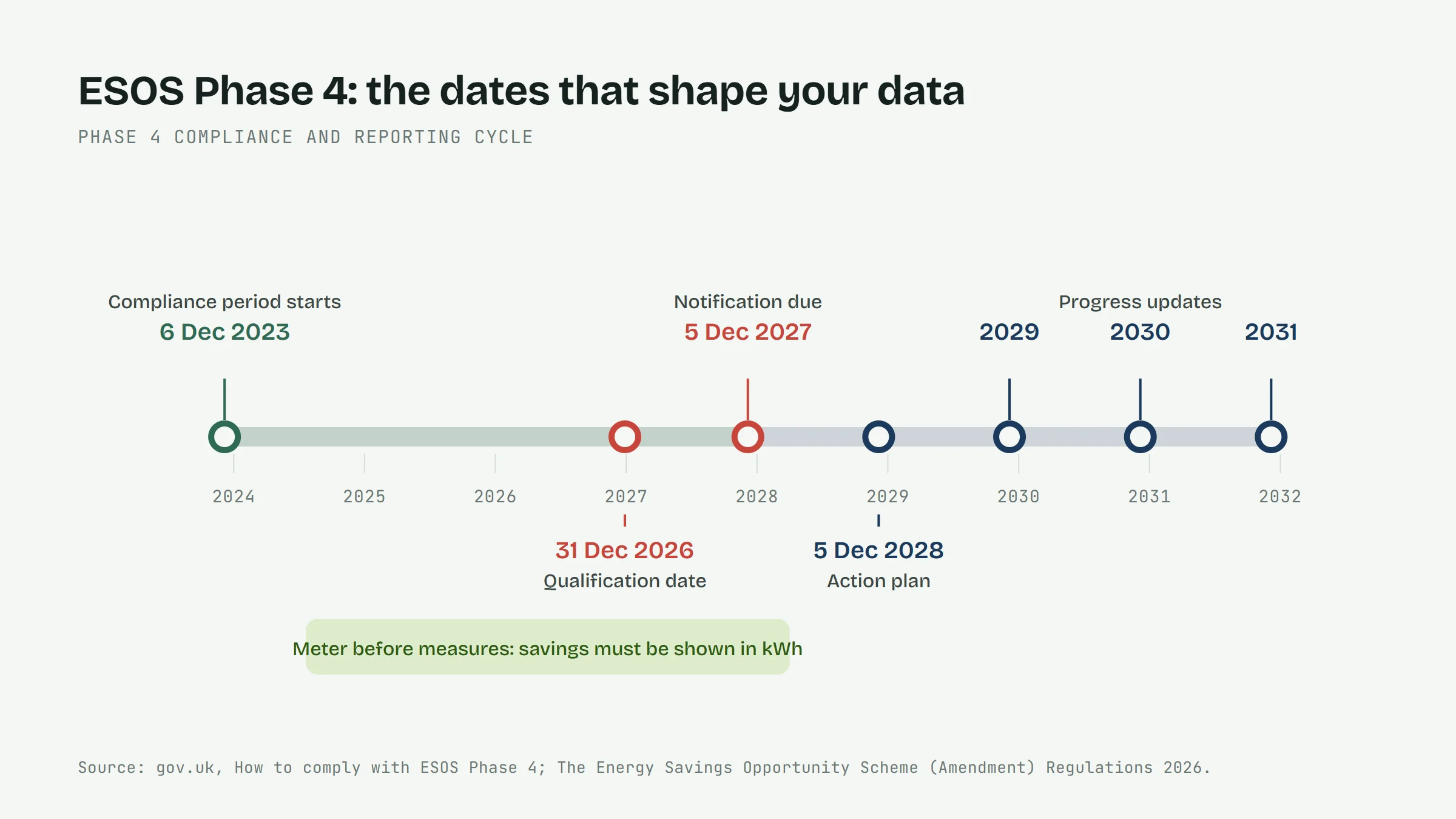
According to the Environment Agency’s Phase 4 guidance, the key dates are:
- 6 December 2023 to 5 December 2027: the fourth compliance period.
- 31 December 2026: the qualification date. Your status on this day decides whether you are in scope.
- 5 December 2027: the deadline for submitting your notification of compliance through MESOS, the online reporting system.
- 5 December 2028: the deadline for your Phase 4 action plan.
- 5 December 2029, 2030 and 2031: three annual progress updates against that action plan. The third update is new for Phase 4.
An organisation qualifies if, on the qualification date, it or any UK undertaking in its group is a large undertaking: 250 or more employees, or an annual turnover above £44 million and an annual balance sheet total above £38 million. Size is judged over two consecutive accounting periods, so businesses that have recently grown or shrunk should check the guidance on borderline cases.
If you also qualified for Phase 3, note that your second Phase 3 progress update is due by 5 December 2026, a few weeks before the Phase 4 qualification date.
What changed for Phase 4
The Energy Savings Opportunity Scheme (Amendment) Regulations 2026 came into force on 22 July 2026. They build on the 2023 amendments that shaped Phase 3, which cut the unaudited allowance from 10% to 5% of total consumption, made energy intensity ratios mandatory and introduced action plans with annual progress updates. The main changes for Phase 4 are:
- Display Energy Certificates and Green Deal assessments are no longer compliance routes. Buildings that relied on them must now be covered by an ESOS audit or ISO 50001.
- An action plan review is now part of the ESOS report. If you had a Phase 3 action plan, you must identify measures that have not been, and will not be, implemented by 5 December 2027, and explain why.
- Energy savings must be reported measure by measure, in kWh. Your report must estimate savings achieved since 6 December 2023, identifying each measure, its category (for example controls improvements or capital investment) and the kWh saved.
- ISO 50001 now works against significant consumption. A certificate issued on or after 6 December 2023 and still valid on 5 December 2027 that covers your total or significant energy consumption removes the need for a lead assessor, an audit and an ESOS report. Partial coverage means auditing the remainder. Energy intensity ratios and the action plan still apply.
- A third annual progress update has been added, taking the reporting cycle to 5 December 2031.
The core coverage rule stays the same: your audit or ISO 50001 certification must cover at least 95% of total energy consumption across buildings, industrial processes, transport and other uses.
Why the data question comes earlier than the deadline
Three parts of the rules make data availability, rather than report writing, the constraint.
The reference period may already have started. Total energy consumption is calculated over 12 consecutive months that include 31 December 2026 and end before 5 December 2027. If you choose calendar year 2026, nine months of it have already passed. For total consumption, invoices and supplier half-hourly data are usually enough. Audit analysis asks for more detail.
Audits must analyse energy consumption profiles where reasonably practicable. The guidance describes static profiles (the split between end uses), time profiles (variation with shifts, weather or season) and time-interval profiles (before and after a change). If you do not use profiles, you must tell the scheme administrator and justify the alternative. A monthly fiscal meter reading cannot show what a production line or chiller plant does at 3am.
Savings evidence needs a “before”. The guidance’s preferred way to estimate savings is data comparison: consumption at the relevant supply point in comparable periods before and after a measure, adjusted for weather and output where practicable. Its own worked example relies on submetering data from the 12 months before an installation. A meter fitted after a project cannot give you that baseline. Any measure planned between now and 2031 is easier to evidence if the relevant load is metered first.
Where continuous metering makes a measurable difference
Sub-metering and interval data help in four places.
- Energy intensity ratios. You need at least one ratio each for buildings, transport, industrial processes and other uses, and the kWh breakdown across those categories must add up to your total. From Phase 4 the Environment Agency publishes this breakdown, so measured splits beat apportioned ones.
- The audit itself. Profiles from interval data let the assessor spend site visits on causes rather than reconstructing load patterns from invoices.
- The savings estimate and action plan review. Per-measure kWh savings since December 2023 are straightforward when each measure has its own before-and-after record.
- Progress updates to 2031. Each update reports the previous 12 months’ savings, is signed off by a director and is published.
An illustrative example of why base load matters, with assumed figures: a site runs 3,000 occupied hours a year, leaving 8,760 − 3,000 = 5,760 unoccupied hours. If out-of-hours base load falls by 20 kW, the annual saving is 20 kW × 5,760 h = 115,200 kWh. Showing that saving credibly needs interval data from before and after the change, with occupancy and weather accounted for.
What is confirmed and what is not
Phase 4 is legislated: the qualification criteria, 31 December 2026 qualification date and 5 December 2027 compliance date are in force.
Net zero is voluntary for Phase 4. The government’s 2022 consultation response proposed a net zero audit element for this phase. Instead, organisations can choose to follow PAS 51215-1:2025 and PAS 51215-2:2025, the BSI standards for a combined energy and decarbonisation assessment. MESOS does not yet accept these voluntary assessments.
Beyond Phase 4, nothing new is legislated. Current guidance gives 31 December 2030 as the next qualification date. The government’s 2026 review of Streamlined Energy and Carbon Reporting (SECR) notes overlap with ESOS and says any changes would be consulted on. No change to ESOS thresholds or replacement of the scheme has been made in regulation, so treat reports of either as proposals until they appear on legislation.gov.uk.
A practical sequence for the next 14 months
- Now: confirm qualification across the group, appoint a lead assessor (unless ISO 50001 covers your significant consumption) and decide your reference period.
- Before year end: identify the loads likely to form your significant consumption and start sub-metering those that are poorly understood.
- During 2027: audit on 12 months of verifiable data, compile per-measure savings since December 2023 and complete any Phase 3 action plan review.
- By 5 December 2027: director sign-off and notification, then keep the same meters running through the progress updates.
How Enverio fits
Enverio does not carry out ESOS audits or submit notifications; those remain with your organisation and its lead assessor. What we provide is the measured data underneath them. Energy consumption monitoring breaks consumption down by site, area and production line, with out-of-hours and base-load analysis. Energy performance adds production-normalised baselines, CUSUM tracking and ISO 50001 energy performance indicator (EnPI) reporting.
Because ESOS allows totals to be calculated from invoices, it also helps if those invoices are right. Electricity bill validation checks supplier bills against metered consumption. If you want to discuss metering ahead of Phase 4, contact us.
Frequently asked questions
Do we need 12 months of sub-metered data before the audit? No. The audit must use 12 months of verifiable data where reasonably practicable, and invoices or supplier meter records count. Where they are not available, the guidance allows reasonable estimates, provided the method is recorded. Sub-metering improves the analysis and savings evidence; it is not a legal prerequisite.
Does ISO 50001 certification remove all ESOS obligations? No. Certification that covers your total or significant consumption, issued on or after 6 December 2023 and valid on 5 December 2027, replaces the lead assessor, audit and report. You must still calculate energy intensity ratios, notify compliance and submit the action plan and progress updates.
Is net zero reporting mandatory in Phase 4? No. Participants can choose to add a decarbonisation assessment using PAS 51215-1:2025, but it is not required and MESOS does not currently accept it.
What happens if we miss the action plan or a progress update? According to the guidance, regulators will not take enforcement action or issue penalties for these. The Environment Agency will, however, publish the failure. Missing the notification of compliance itself can lead to civil penalties.
Sources
- Environment Agency and DESNZ: Energy savings opportunity scheme (ESOS) – find out if you qualify and how to comply
- Environment Agency: How to comply with the Energy Savings Opportunity Scheme (ESOS) phase 4
- The Energy Savings Opportunity Scheme (Amendment) Regulations 2026 (SI 2026/701)
- The Energy Savings Opportunity Scheme (Amendment) Regulations 2023 (SI 2023/1182)
- The Energy Savings Opportunity Scheme Regulations 2014 (SI 2014/1643)
- DESNZ: Strengthening the Energy Savings Opportunity Scheme – consultation and government response (July 2022)
- DESNZ: 2026 post-implementation review of the Streamlined Energy and Carbon Reporting regulations
Let us measure what is happening on your site.
In a one-hour call we look at your existing setup and set out exactly which measurement points are needed and what you would be able to see.